

When configuring a vSAN ESA cluster, you may encounter servers that have asymmetrical disks. But what does this mean in practice, and what are the impacts?
The asymmetry can occur both in terms of the available storage capacity on each host and the type of disk being used.
What Is an Asymmetrical Cluster?
An asymmetrical cluster is one in which one or more hosts contribute a different amount of resources compared to the other hosts in the cluster.
It’s important to note that vSAN does support asymmetrical configurations—however, this approach brings some consequences that need to be considered.
Symmetry vs. Asymmetry: Failure Scenarios
To understand how a symmetrical and an asymmetrical cluster behave, let’s consider a failure scenario:
Scenario 1 – Symmetrical Cluster:
In a 5-host environment with 50% utilization, if one host fails, overall utilization on the remaining hosts increases to about 62%.

Scenario 2 – Asymmetrical Cluster:
Now imagine a 5-host environment with 50% utilization, but one host has 2x more storage capacity of the others. If that specific host fails, utilization would jump from 50% to about 75%.
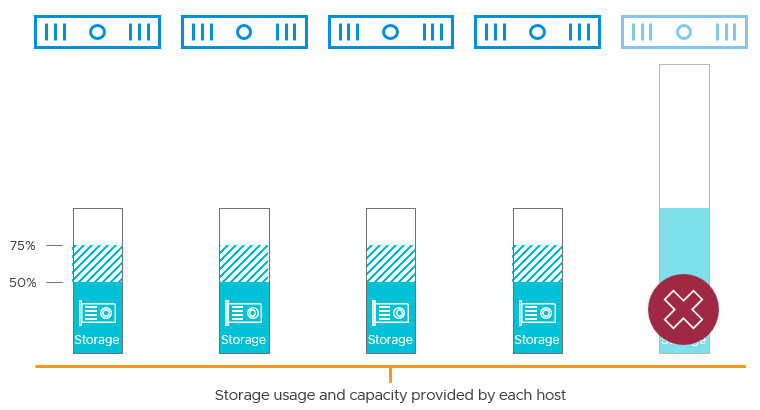
Scenario 3 – Critical Asymmetry:
Finally, suppose a 5-host environment with 66% utilization, where one host has 3x the capacity of the others. If that host fails, utilization would rise to 115%, exhausting cluster resources and compromising the environment’s health.
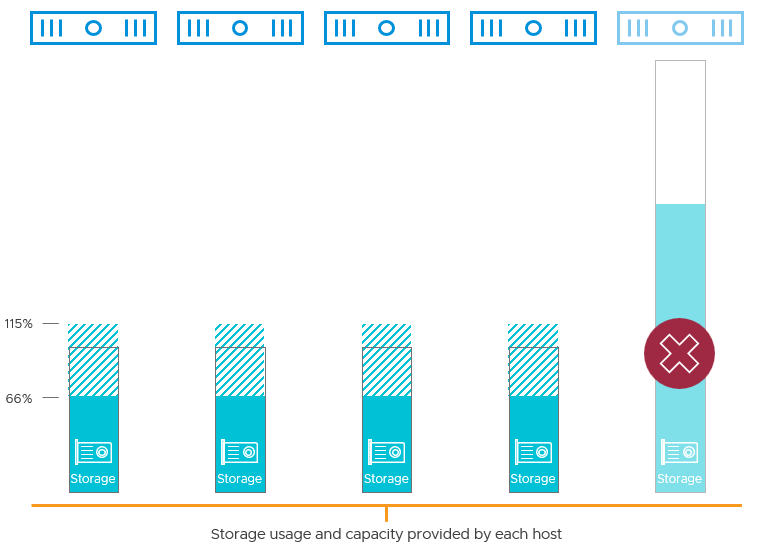
These examples show how losing a single host in an asymmetrical scenario can cause much more severe impacts than in a symmetrical cluster.
It’s also worth noting that management complexity increases as the number of hosts with different configurations grows.
Conclusion
In summary, choosing an asymmetrical cluster configuration should be a conscious decision, based on three main factors:
- Consumed Capacity – The higher the utilization, the greater the risk of rapid capacity exhaustion in case of failure.
- Number of Hosts – This determines how much losing a host affects cluster resilience.
- Degree of Asymmetry – The greater the differences in resources between hosts, the more significant the potential impact of a failure.
In the next article, I’ll explain that cluster asymmetry also involves the types of disks in the server. Stay tuned!

 lanznot.com
Leave a comment