
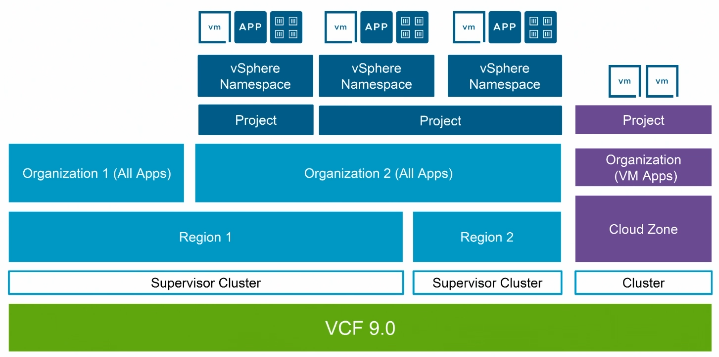
One of the key announcements in VCF Automation 9 is the introduction of two types of organization – Organizations for All Apps and Organizations for VM Apps. While both organization types provide a robust automation platform, it’s important to understand the differences between them and when to use each one.
Organization for All Apps
We could say that Broadcom is encouraging customers to embrace the Org for All Apps model. According to Broadcom, this model is design to deliver the full VCF 9 experience. This is reinforced by the fact that the alternative organization type — Organization for VM Apps — is disabled by default.
In Organization for All Apps, you must create a region to make vSphere compute, memory, and storage resources available to VCF Automation. It’s also possible to create multiple organizations within the same instance.
Additionally, All Apps org is designed to deploy different types of workloads, like VMs, VKS, VKS services and Pods – all using the same API – the vSphere Supervisor.
Organization for VM Apps
Broadcom also provides the Organization for VM Apps, which delivers an experience similar to VMware Aria Automation 8.x.
The familiar concept of Cloud Zones is still present. Broadcom’s goal with this organization type is to facilitate the transition to the All Apps model for customers who already have Automation deployed.
However, VM Apps is disabled by default. To enable it you must to activate the “Classic Tenant Creation” feature flag. Also, it’s only possible to create one organization of this type.

When to use All Apps vs VM Apps?
| Org for All Apps | Org for VM Apps | |
| Environment | Default experience | Disabled by default |
| Quantity | Multiples | Only one. |
| Resource Placement | Regions | Cloud Zones |
| Use case | VMS, K8s, Services and Pods | Only VMs. |
Org for All Apps

Org for VM Apps

All Apps organizations are used to provision different types of workloads – including VMs, Kubernetes, Pods and services (like ArgoCD, Harbor and so on).
However, VM Apps organizations are intended for current users of VMware Aria Automation who want to continue their journey with minimal disruptions and doesn’t require Kubernetes or containers workloads
Nevertheless, it is possible to use both organization types within the same VCF Automation instance. However this presents a limitation: the vCenter server can be associated with only one organization type.
Provider Consumption Organization
Although I’d discussed about two types of organizations, we actually have three. The Provider Consumption Organization, or PCO, is an special type of organization that allows provider admins to deploy and manage their own workloads.
It also allows to share content libraries and orchestrator workflows across different organizations.
That one is also disabled by default and must be enabled via the feature flag page. Once enabled, it can’t be deleted, only disabled.

Leave a Reply